

Introduction
Baptism is one of the most visible and powerful symbols in the Christian walk. But with so many denominations offering different teachings—sprinkling vs. immersion, infant vs. believer’s baptism, symbolic vs. salvific—it’s critical to return to Scripture itself.
This study will walk through the origin, meaning, and importance of baptism. We’ll explore how it connects to covenant, identity, cleansing, and resurrection—and why Jesus Himself submitted to it. More than a ceremony, baptism is a declaration: that the old life is buried, and the new life now walks in resurrection power.
Hebrew & Greek Definitions
🔹 Hebrew (ṭābal) – To dip, immerse, or plunge
🔹 Greek (baptizō) – To submerge, immerse, cleanse by dipping, overwhelm completely
✅ Biblical baptism always implies full immersion, not sprinkling.
Baptism fulfills both Old Testament cleansing laws and foreshadows Christ’s death and resurrection:
📖 Romans 6:3–4 – “Know ye not, that so many of us as were baptized into Jesus Christ were baptized into his death?… we also should walk in newness of life.”
📖 Matthew 3:15 – “Suffer it to be so now: for thus it becometh us to fulfill all righteousness.”
🔎 Jesus’ baptism marked the beginning of His ministry, identifying Him with sinners so He could redeem them.
Occurrences in Scripture
Baptism appears consistently throughout the New Testament as a vital part of the believer’s response to the gospel. From the moment John the Baptist began his ministry, to the conversion of thousands in the book of Acts, baptism is closely tied to repentance, faith, and entrance into the body of Christ.
While the Old Testament contained ritual washings, the New Covenant reveals baptism as the public sign of dying to the old life and being raised in Christ. Every mention in Scripture reinforces its spiritual significance and its role in the process of salvation and discipleship.
🔹 Baptism is mentioned directly or indirectly about 100 times in the New Testament.
🔹 First appears with John the Baptist (Matthew 3:1–6) and continues through the Acts of the Apostles as a critical step of faith.
🔹 Both Jesus’ baptism and His command to baptize (Matthew 28:19) show it is no optional ritual—but part of the gospel message itself.
Types of Use in Scripture
🔹 Baptism of repentance – Initiated by John the Baptist
🔹 Baptism of Jesus – A model of obedience and inauguration into ministry
🔹 Baptism into Christ’s death and resurrection – Described by Paul (Romans 6:3–4)
🔹 Baptism of the Holy Spirit – Empowering believers (Acts 1:5, Acts 2:38)
🔹 Baptism in fire – Often used as judgment or purification (Matthew 3:11)
1️⃣ Baptism Signifies Burial and Resurrection
📖 Colossians 2:12 – “Buried with him in baptism, wherein also ye are risen with him…”
🔎 Baptism is not just a symbol—it is a public death certificate of the old self and a resurrection proclamation of new life.
2️⃣ Baptism Is Commanded, Not Suggested
📖 Mark 16:16 – “He that believeth and is baptized shall be saved; but he that believeth not shall be damned.”
📖 Acts 2:38 – “Repent, and be baptized every one of you in the name of Jesus Christ…”
🔎 The early church treated baptism as part of conversion—faith, repentance, and baptism were inseparable.
3️⃣ Baptism Is for Believers, Not Infants
📖 Acts 8:36–37 – “If thou believest with all thine heart, thou mayest. And he answered… I believe that Jesus Christ is the Son of God.”
🔎 Baptism always follows personal belief and repentance—not a decision made by someone else. There is no example in Scripture of infant baptism.
4️⃣ Baptism Does Not Save by Water Alone
📖 1 Peter 3:21 – “The like figure whereunto even baptism doth also now save us… not the putting away of the filth of the flesh, but the answer of a good conscience toward God…”
🔎 Baptism is a response of faith, not a magical act. Without repentance and belief, water is just water.
Cross-References & Supporting Scripture
Acts 2:38
Colossians 2:12
Acts 8:36–38
Galatians 3:27
1 Peter 3:21
Baptisms in the Book of Acts
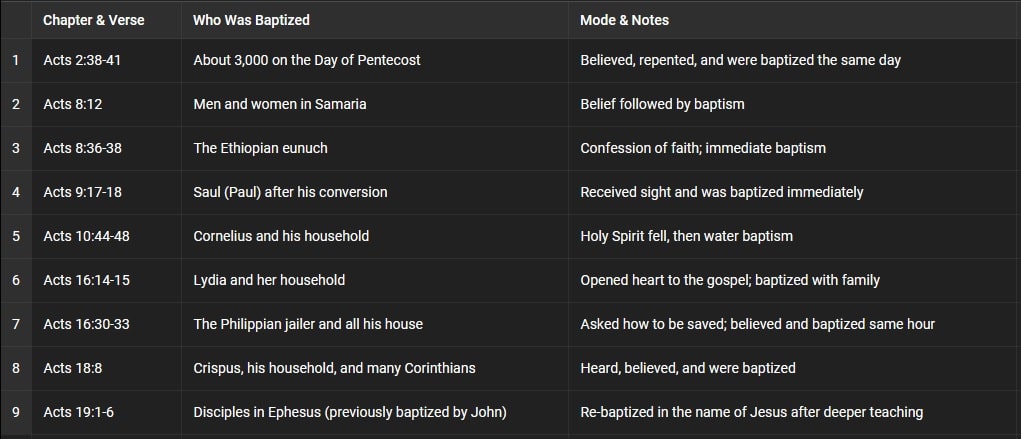
Here is a chart detailing the major baptisms recorded in the Book of Acts. It includes who was baptized, the scripture references, and key notes on how each baptism took place.
Historical & Cultural Context
In Jewish culture, ritual washings were common—especially for temple preparation and purification. John the Baptist’s call to public immersion for repentance was radical, setting the stage for the New Covenant. In Roman society, public identity was tied to citizenship or allegiance—baptism became the declaration that one no longer belonged to Caesar, but to Christ.
The Thief on the Cross Was Not Baptized
📖 Luke 23:43 – “Today shalt thou be with me in paradise.”
🔎 God sees the heart. Baptism is not a legalistic requirement, but the normal fruit of obedience for those who can fulfill it.
💡 Final Reflection & Life Application
Baptism is not a religious tradition—it is a line in the sand. It separates the old life from the new, death from resurrection, darkness from light. In a world where many are baptized into religion, denomination, or tradition, God calls us to be baptized into Christ alone.
📌 If you’ve believed but never been baptized—why wait?
📌 If you’ve been baptized without understanding or faith—seek the truth.
📌 If you’ve already been baptized in faith—live out the new life it represents!
📖 Galatians 3:27 – “For as many of you as have been baptized into Christ have put on Christ.”
➡️ May we all rise from the waters of surrender as a new creation, walking in obedience, and clothed in the righteousness of Christ.